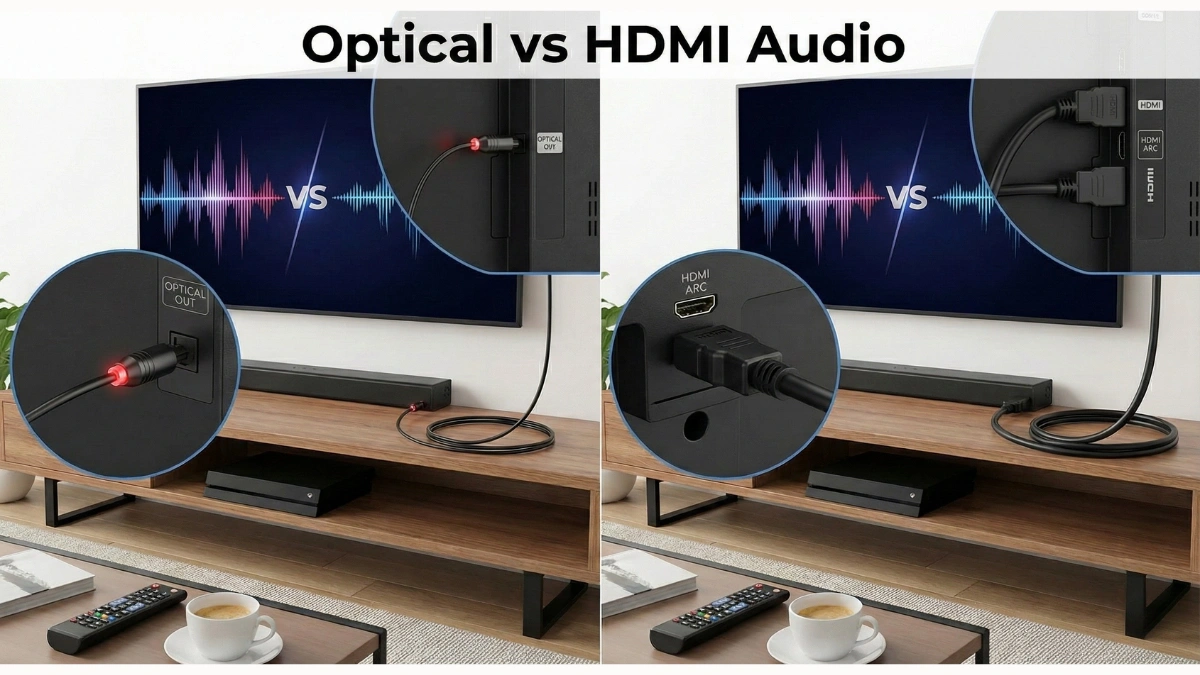
Connecting a soundbar or AV receiver seems simple, yet many home audio issues start with choosing the wrong audio connection. Optical and HDMI both carry digital audio, but they behave very differently and support different features. Understanding optical vs HDMI audio helps ensure your system delivers the sound quality and convenience you expect.
This guide explains how each connection works, when a Toslink cable makes sense, when HDMI is the better option, and how to choose the right connection for soundbars and AV receivers in Australian homes.
How Optical and HDMI Audio Work
Optical audio uses light to transmit sound from a TV to a sound system through a Toslink cable. Because it is light-based, it is immune to electrical interference and very reliable for basic audio formats.
HDMI audio sends sound and video together through a single cable. It supports higher bandwidth and advanced audio formats, making it the standard for modern home theatre systems.
Optical Audio Explained for Soundbars
Optical audio is simple and dependable. It works well for stereo sound and basic surround formats and is widely supported by TVs and soundbars.
Many buyers choose optical because it is easy to set up and avoids compatibility issues, especially with older TVs or simpler soundbar systems.
HDMI Audio Explained for AV Receivers and Modern Soundbars
HDMI audio supports far more data than optical. It allows high-quality surround formats and enables features like volume control through the TV remote using ARC or eARC.
For AV receivers and advanced soundbars, HDMI provides better integration and long-term compatibility.
Optical vs HDMI Audio Comparison
| Feature | Optical Audio (Toslink) | HDMI Audio |
|---|---|---|
| Audio formats | Stereo, basic surround | Advanced surround formats |
| Bandwidth | Limited | High |
| Interference | Immune | Very resistant |
| Single-cable setup | Audio only | Audio and video |
| TV remote control | No | Yes with ARC/eARC |
| Future-proofing | Limited | High |
This comparison shows why HDMI has become the preferred option for modern systems.
When Optical Audio Is the Better Choice
Optical audio is ideal when using older TVs, basic soundbars or systems that do not support HDMI ARC or eARC. It is also useful in setups where electrical interference is a concern.
For simple TV and soundbar combinations, optical delivers reliable sound without complexity.
When HDMI Audio Is the Better Choice
HDMI is the better choice for AV receivers, surround sound systems and newer soundbars. It supports higher-quality audio formats and simplifies control by allowing the TV remote to manage volume and power.
If your system supports HDMI ARC or eARC, using HDMI unlocks the full potential of your equipment.
Optical Audio Limitations Buyers Should Know
Optical cables cannot carry advanced surround formats and do not support audio return control features. This means you may need multiple remotes and may not get the best audio performance from newer content.
These limitations become more noticeable as content quality improves.
HDMI ARC vs HDMI eARC Explained Simply
HDMI ARC allows basic audio return from TV to sound system. HDMI eARC expands this capability, supporting higher-quality audio formats and more reliable communication.
For buyers investing in premium soundbars or AV receivers, eARC support is a key feature.
Choosing the Right Cable for Your Setup
Choose an optical Toslink cable for basic setups and older equipment. Choose HDMI cables for modern TVs, soundbars and receivers that support ARC or eARC.
Always use certified cables to avoid signal dropouts or compatibility issues.
Optical and HDMI Audio in Australian Homes
Australian homes often have wall-mounted TVs and longer cable runs. Optical cables work reliably over moderate distances, while HDMI cables require quality construction for stable audio return.
Selecting the right cable improves reliability and simplifies daily use.
Final Verdict: Optical audio is simple and dependable for basic sound setups. HDMI audio is more powerful, more convenient and better suited for modern home theatre systems.
Choosing the right connection ensures your soundbar or AV receiver performs exactly as intended.
Frequently Asked Questions
Is optical audio better than HDMI for soundbars?
Optical is reliable for basic soundbars, but HDMI offers better features and audio quality when supported.
Does HDMI improve sound quality over optical?
Yes, HDMI supports more advanced audio formats that optical cannot carry.
What is a Toslink cable used for?
A Toslink cable is used for optical audio connections between TVs and sound systems.
Can I control volume with optical audio?
No. Optical audio does not support TV remote volume control.
Should I upgrade from optical to HDMI?
Yes, if your TV and sound system support HDMI ARC or eARC.